I Googled It For You

Home and household projects

Plan the work before the work starts.

Estimate materials, energy costs, moving expenses, and project quantities with tools that show their assumptions. Start with the numbers, then use the guidance to decide what needs a closer look.

What this hub helps you do

Use this hub for the practical parts of home projects: measuring, estimating, budgeting, comparing options, and organizing a move. These tools help you make a better starting plan; they do not replace product instructions, local requirements, or qualified professional judgment.

Start here

Moving

Moving Quote Comparison

Compare up to three moving quotes side by side, including fees, services, coverage, and contingency-adjusted totals.

Put competing estimates into the same format so missing services, extra fees, and different coverage levels are easier to spot.

Open calculator
Moving

Packing Supply Estimator

Estimate boxes and packing supplies by room, then add your own prices for a private packing-supply budget.

Choose rooms and packing intensity to create a starting shopping list without sending your inventory or prices to a server.

Open calculator

Home

Paint Coverage Calculator

Estimate paint for a room or wall with coats, openings, coverage, and waste included.

Account for doors, windows, multiple coats, and a practical waste allowance before buying paint.

Open calculator

Home

Concrete and Gravel Calculator

Estimate volume, concrete bags, or gravel weight for rectangular and circular projects.

Switch between U.S. and metric measurements, include waste, and use editable bag yield or gravel density assumptions.

Open calculator

Home

Electricity Cost Calculator

Estimate appliance energy use and cost by day, month, and year from watts, usage time, and your rate.

Compare appliances using your own electricity rate without pretending to model every utility’s taxes, fees, or tier rules.

Open calculator

Home

Recipe Scaling Calculator

Scale ingredient quantities up or down for a different number of servings while preserving the original ratio.

Enter the original serving count and the desired count to resize every ingredient consistently.

Open calculator

Understand the decisions

Learn and plan

Practical starting points

Common questions

Before you calculate

Plan a project in five questions

A useful estimate starts with a clear scope. Write down what you are doing, what must be measured, what you already know, and what could change the result before you start shopping.

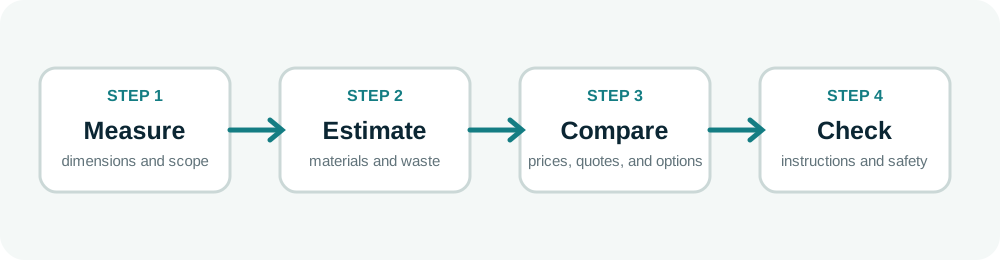
A four-step home project planning flow: measure, estimate, compare, and check.
A reliable project plan moves from measurements to an estimate, then checks prices, instructions, and safety before work begins.
  1. 1

    What is the finished result?

  2. 2

    What dimensions or quantities matter?

  3. 3

    Which product or rate assumptions apply?

  4. 4

    What waste, delivery, or setup belongs in the budget?

  5. 5

    What part should be checked by a professional?

Better estimates

Treat the result as a starting range.

Coverage, bag yield, energy use, vehicle efficiency, and moving quantities are all estimates. The calculator can make the arithmetic consistent, but your measurements and the product’s instructions determine whether the estimate fits the real job.

Record the assumptions you used: dimensions, units, number of coats, waste allowance, rate, vehicle efficiency, or quote inclusions. If one of those changes, run the estimate again instead of quietly carrying the old number forward.

A simple purchase check

  • Measure twice: confirm dimensions and units before ordering.
  • Read the label: use the product’s stated coverage or yield when it differs from a default.
  • Plan the last step: include delivery, cleanup, disposal, storage, or return limits.
  • Keep a cushion: avoid treating a precise-looking result as a guarantee.

Safety and boundaries

Know when to pause and ask for help.

A calculator can estimate quantity or cost, but it cannot inspect a structure, verify a circuit, evaluate soil or drainage, identify hidden damage, or determine which local requirements apply. Stop and consult a qualified professional when the work could affect structural safety, electrical systems, gas, plumbing, roofing, hazardous materials, permits, or other regulated work.

The tool pages are educational planning aids. Follow manufacturer instructions and local requirements, and do not use an estimate as a substitute for a site-specific assessment.