Money
Tip Calculator
Calculate a tip, total bill, and per-person share while seeing the math behind the result.
Enter the bill, tip rate, tax, and group size to see what each person owes and how the total is built.
Open calculatorMoney and everyday comparisons
Compare prices, understand borrowing costs, plan a payoff, and see how savings can grow. These tools are built for everyday decisions, with the math explained instead of hidden behind a result.
Use this hub when you need a quick estimate or a clearer explanation before you buy, borrow, save, or invest. Start with the calculator that matches your question, then use the guides to understand the assumptions behind the number.
Start here
Money
Calculate a tip, total bill, and per-person share while seeing the math behind the result.
Enter the bill, tip rate, tax, and group size to see what each person owes and how the total is built.
Open calculatorMoney
Find the sale price and total savings, including optional stacked discounts and sales tax.
Useful for checking a sale price before checkout and understanding whether multiple discounts are applied one after another.
Open calculatorMoney
Compare package prices by ounce, fluid ounce, metric quantity, or individual item.
Normalize different package sizes and units so you can compare the actual cost of what you are buying.
Open calculatorMoney
Estimate a payoff date, total interest, and how much time an extra monthly payment could save.
Compare your current payment with an accelerated plan and see how additional money changes the payoff timeline.
Open calculatorMoney
Calculate a monthly savings target or estimate when regular contributions could reach a goal.
Work backward from a target amount and date, with optional interest included when your account earns a return.
Open calculatorMoney
Compare simple and compound interest, effective annual yield, and year-by-year balances.
See how principal, rate, time, and compounding frequency change the balance instead of relying on a single headline number.
Open calculatorMoney
Build an itemized moving budget with transportation, travel, setup costs, and a contingency cushion.
Combine known quotes with your own estimates for fuel, lodging, packing, storage, cleaning, and the costs that appear late in a move.
Open calculatorMoney
Add sales tax, remove tax from a total, or find the effective rate with each formula explained.
Use it when a posted price excludes tax, when you need to separate tax from a receipt total, or when checking a quoted rate.
Open calculatorMoney
Solve common percentage questions, percentage change, and increases or decreases with the formulas shown.
Handle everyday comparisons such as discounts, markups, growth, reductions, and the percentage represented by one value of another.
Open calculatorMoney
Estimate fixed monthly principal and interest, total interest, and an amortization schedule.
Explore how loan amount, rate, term, and optional extra costs affect the payment and the total paid over time.
Open calculatorMoney
Estimate fuel needed, trip cost, cost per mile, and each traveler’s share using your own route and vehicle values.
Adjust distance, fuel economy, fuel price, and passengers to create a transparent trip estimate for driving or moving.
Open calculatorUnderstand the decisions
See the difference between simple and compound interest, and why time and compounding matter.
A practical way to compare borrowing or savings options without focusing on one headline number.
A plain-language introduction to stocks, bonds, funds, dividends, risk, and diversification.
Practical starting points
Start with the discount calculator to see the sale price, optional sales tax, and total savings.
Open the calculatorCompare different package sizes by the same unit instead of relying on the shelf price.
Open the calculatorEstimate payoff timing and interest, then compare the effect of an additional monthly payment.
Open the calculatorWork backward from a target amount and date, with optional growth included in the estimate.
Open the calculatorRead the plain-language explanation below for ownership, lending, pooled investments, and risk.
Read the explanationTake it with you
A clearer starting point
Interest is the price of using someone else’s money, or the return you may earn for letting someone else use yours. The rate tells you how fast the balance changes; the time, starting amount, contributions, withdrawals, and compounding schedule determine how much that change adds up.
The same word can describe money flowing in two directions: a lender charges interest on a loan, while a saver may earn interest on a deposit. The arithmetic is similar, but the practical result is opposite—interest can help your balance grow or make a debt more expensive.
The principal is the starting amount. For savings, it can be the opening deposit. For a loan, it is the amount borrowed before interest and fees.
Bigger principal usually means bigger dollar interest.
The rate describes the percentage applied to a balance over a stated period. Check whether it is an annual rate, a periodic rate, fixed, variable, nominal, or an APY.
A percentage needs a time period to be meaningful.
Interest can be calculated daily, monthly, quarterly, or annually. The number of periods and what happens to each interest charge affect the result.
More time creates more opportunity for growth—or cost.
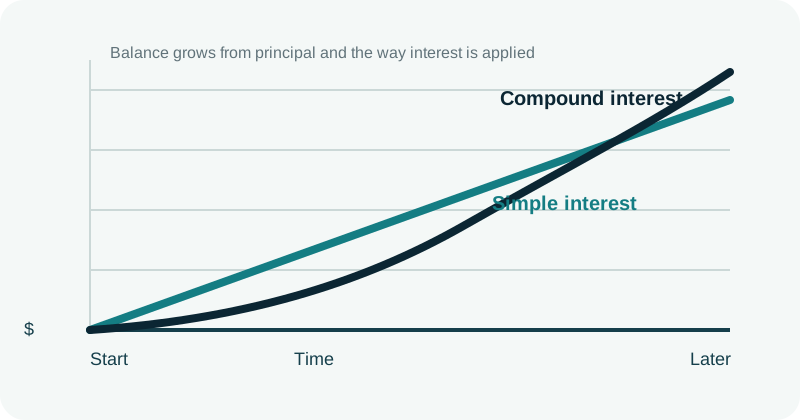
Simple interest is calculated on the original principal rather than repeatedly adding prior interest to the amount used for the next calculation. It is useful for learning the basic relationship among principal, rate, and time.
Interest = principal × rate × time
Example: $1,000 at 5% simple interest for 2 years produces $100 of interest: $1,000 × 0.05 × 2. The ending balance would be $1,100 before taxes or fees.
Compound interest means earning interest on the original money and on interest already added along the way. With the same $1,000 at 5% compounded annually, year one ends at $1,050; year two earns 5% on $1,050, ending at $1,102.50.
Growth depends on the balance, rate, time, and compounding frequency.
Compounding can help savings grow, but it can also make unpaid debt grow. It does not guarantee a positive investment return or remove the cost of fees, taxes, or inflation.
With compound interest, the balance may be updated daily, monthly, quarterly, or annually. A more frequent schedule can produce a different result because interest is added to the balance sooner. Compare offers using the same time period and the disclosed APY or effective annual yield when available—not just the advertised rate.
| Term | Plain-language meaning | What to check |
|---|---|---|
| Interest rate | The stated rate used to calculate interest. | Is it annual or periodic? Fixed or variable? Does it exclude fees? |
| APR | A yearly measure of borrowing cost that can include the interest rate and certain loan fees. | Compare APR with APR, and read the loan disclosure for included and excluded charges. |
| APY | A yearly yield that reflects the effect of compounding on a deposit product. | Check the balance requirements, term, fees, and whether the rate can change. |
| Compounding frequency | How often interest is calculated and added or charged. | Daily and monthly schedules can produce different results from annual compounding. |
Regular deposits increase the principal that can earn interest. The earlier a deposit is made, the more time it may have to participate in growth. The result depends on the deposit amount, timing, rate, and compounding method.
Withdrawals reduce the balance available for future growth. A withdrawal may also trigger a penalty, tax, or loss of future interest depending on the account.
Use the savings goal calculator to estimate a required monthly contribution or test a target date. Use the interest calculator to compare simple and compound growth from a starting balance.
When you borrow, interest increases the amount you must repay. A payment may cover interest first, with the remainder reducing principal. If the balance stays high, more future interest can be charged.
Extra principal payments can reduce the balance sooner and may reduce total interest, but check for prepayment rules, fees, minimum-payment requirements, and how the lender applies extra money.
Use the loan payment calculator for a fixed-rate payment estimate or the debt payoff calculator to compare payoff timing and extra payments.
A savings product may state a rate. Investments usually have uncertain returns that can be positive or negative. Do not treat an estimated investment return as a promise.
Even when a balance increases, rising prices may reduce what that money can buy. A nominal rate is not the same as an inflation-adjusted result.
Account fees, loan fees, taxes, withdrawal penalties, and investment expenses can change the amount you actually keep or owe.
Sources and review: Reviewed September 29, 2026. This explanation was checked against the Consumer Financial Protection Bureau’s compound-interest explanation, its interest-rate and APR guide, Investor.gov’s compound-interest calculator guidance, and its introduction to saving and investing.
Educational boundary: This page explains general concepts and calculator assumptions. It is not personalized financial, tax, lending, or investment advice. Confirm current rates, fees, disclosures, and account terms with the provider.
Compare the whole picture
A rate is only one part of a money decision. When comparing loans or other offers, look at how often interest is applied, required fees, the payment schedule, the total amount paid, and whether the rate can change. An estimate can help you compare scenarios, but the lender’s disclosures and agreement control the actual terms.
A useful comparison habit: write down the amount received or deposited, every required fee, the payment amount, the number of payments, and the total paid. Then compare like with like.
Investing Basics
Investing means putting money into something that may produce income, increase in value, or both. Unlike a bank balance with a stated interest rate, an investment can lose value. The right starting point is not “What will make the most money?” It is “What am I trying to do, when will I need the money, and how much uncertainty can I handle?”
This lesson explains the building blocks. It is general education, not a recommendation to buy or sell anything.
| Investment | What you own | How it may make money | Main things to understand |
|---|---|---|---|
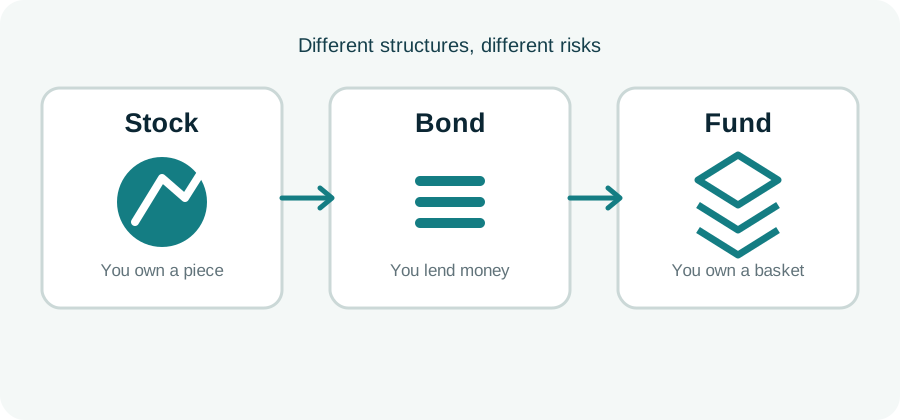
| Stock | A small ownership interest in a company. | The share price may rise; the company may pay dividends. | Company results, market conditions, volatility, and the possibility of losing money. |
| Bond | A loan made to an issuer such as a government or company. | Interest payments and possible repayment of principal; a bond may also change in market value. | Credit risk, interest-rate changes, maturity, inflation, and whether the bond can be sold easily. |
| Mutual fund | A share of a pooled portfolio managed under the fund’s rules. | The underlying holdings may rise in value or produce dividends and interest. | Holdings, strategy, fees, risks, purchase/redemption rules, and the fund’s prospectus. |
| ETF | A share of a pooled portfolio that trades on an exchange. | The portfolio may rise in value or produce dividends and interest. | Holdings, fees, trading price, bid-ask spread, and whether the fund is broad or narrowly focused. |
A stock represents an ownership share in a company. Owners may benefit if the company grows and the market values it more highly. Some companies distribute part of their profits as dividends, but dividends can change or stop. A stock has no promised repayment date, and its market price can move sharply.
A bond is a loan. The issuer borrows money, generally promises interest, and usually promises to repay the principal at maturity. That promise depends on the issuer’s ability to pay. A bond can still lose market value before maturity, especially when newer bonds offer different interest rates.
A mutual fund or ETF pools money and buys a portfolio of stocks, bonds, cash instruments, or other assets. A fund can make it easier to own many holdings, but “fund” does not automatically mean safe or diversified. A narrowly focused fund can still depend heavily on one industry, country, or type of asset.
Cash and savings accounts are often used for short-term needs and emergency reserves. They may offer less opportunity for long-term growth than investments, but the balance is generally easier to access and less exposed to daily market price changes. The right place for money depends on when it will be needed.
A return is the change in value or income produced by an investment over a period of time. It may come from more than one source:
A stated return does not tell you what you will keep. Fees reduce results. Inflation reduces what money can buy. Taxes may affect what reaches you. A useful comparison asks what the investment earned, what it cost, what risks it took, and whether the money was available when needed.
Illustration: if an investment gains 6% but fees and taxes reduce the result, the amount you keep is less than 6%. This is why comparing only the headline return can be misleading.
Prices can fall because of company news, economic conditions, interest rates, or investor expectations.
A bond issuer may fail to make promised payments. Higher promised yields can reflect higher perceived risk.
Prices may rise faster than your money grows, reducing its future purchasing power.
An investment may be difficult or expensive to sell when you need the money.
Diversification means spreading money among different investments so one company or holding is not solely responsible for the result. It can reduce the damage from one poor outcome, but it cannot prevent losses across the whole market.
Asset allocation is how money is divided among broad groups such as stocks, bonds, and cash. A mix that fits a long-term goal may be inappropriate for money needed soon.
Owning several funds does not guarantee diversification. Check whether they hold many of the same companies or concentrate on the same sector.
Your time horizon is how long until you expect to use the money. A short horizon gives you less time to wait for a market decline to recover. A longer horizon may provide more time for ups and downs, but it does not remove risk.
Your risk tolerance is how much uncertainty and potential loss you can withstand emotionally and financially. The most aggressive option is not automatically the best option if a drop would cause you to sell at the wrong time.
A 401(k), IRA, or taxable brokerage account is not itself a stock or bond. It is an account with rules for contributions, taxes, withdrawals, and available investments. The same fund can have different consequences depending on which type of account holds it. Employer contributions, vesting rules, fees, and withdrawal restrictions also matter in workplace plans.
An employer-sponsored plan may offer payroll contributions, a limited menu of investments, and possible employer contributions. Read the plan’s fees and vesting rules.
An individual retirement account has federal tax rules and contribution limits. Traditional and Roth arrangements can treat contributions and withdrawals differently.
A brokerage account can hold investments outside a retirement plan. Taxes may apply to income and realized gains, and the account has its own fees and terms.
“A higher return is always better.” Not if it comes with risks, fees, taxes, or a time horizon that does not fit your goal.
“A fund cannot lose money.” Funds can lose value because the securities they hold can lose value. Diversification reduces concentration risk; it does not guarantee a profit.
“A bond is always safe.” Bonds have issuer, interest-rate, inflation, liquidity, and market risks. A bond’s price can fall before maturity.
“Past performance tells me what will happen next.” Past performance can describe what happened, but it cannot guarantee future results.
Sources and review: Reviewed September 29, 2026. This explanation was checked against Investor.gov’s investment-products overview, its asset-allocation and diversification guide, its mutual fund and ETF overview, FINRA’s investing basics, and the IRS retirement-plan information.
Educational boundary: This page is general education, not personalized investment, tax, or legal advice. Rules, fees, products, and tax treatment can change. Confirm current details in official account documents and consider qualified professional advice for your situation.
Help us keep it useful
Send a correction or tell us what would make this page more helpful. Please include the page address and the specific detail you are referring to.